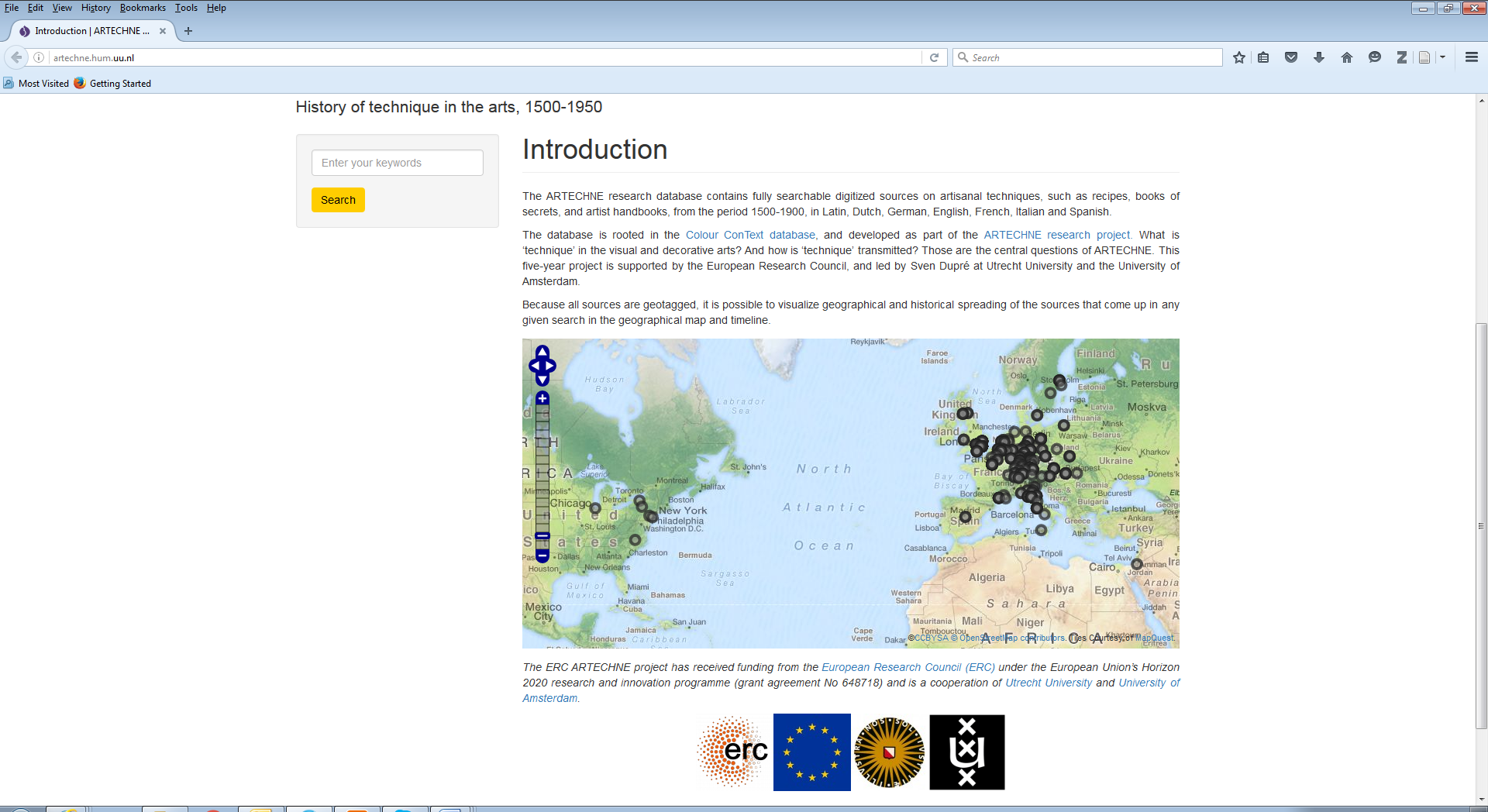
As mentioned in the post introducing the ARTECHNE project
at Utrecht University last month, we are in the process of creating a
database containing recipes, artist handbooks, and art theoretical texts
that can clarify the development of the use of the term ‘technique’, as
well as related terms referring to processes of making and doing. The
database is linked to Geographical Information Software (GIS), thus
creating an online historical semantic map of ‘technique’. Such maps are more than merely nice illustrations; they can reveal connections that remain hidden otherwise.
We are in the fortunate position where we can build the database on an existing one, namely the excellent Colour ConText database.
However, we do not simply want to offer a copy of the Colour ConText
database, we want to integrate it with other sources on artisanal
practices and theories, such as recipes, books of secrets, art
theoretical texts, and artist handbooks, from the period 1500-1900, in
Latin, Dutch, German, English, French, Italian and Spanish. The entire
database has to be searchable with advance searches, allowing users to
search full text for occurrences of terms, in particular geographical or
linguistic areas and periods, or to trace the changing uses and
meanings of particular terms over time, linking various forms of terms
and different terms with a similar meaning in relational tables and
glossaries. Preview of the new database website
For example, if we want to know how instructions for making paint
have changed in the low countries between 1600 and 1900, we want to be
able to select all available sources from that period and area and
search them for imperatives, nouns, measurements, and particular
ingredients. We also want to be able to distinguish between printed and
manuscript sources, artist handbooks and household recipes books, and
ideally we want to be able to search annotations and marginalia too, as
well as differences between various editions of the same work. That
means a lot of different parameters have to be specified for each
source, and everything we include must be carefully checked before it is
added.
One of the problems we encountered when selecting the first sources
we wanted to add was the low reliability of Optical Character
Recognition software when used on early modern printed sources – a
problem I have written about on my own blog
before. We do not just want to combine existing digitized sources in
our database, but also to add texts that have not been digitized and
made searchable thus far. However, that often involves lengthy
correction processes. One of the solutions we are considering is crowd
sourcing such corrections. Fortunately, we can also add many digitized
sources that are available under Creative Commons licenses (i.e. from
the Digital Library of the Netherlands), and various researchers have contacted us to discuss adding their own datasets to the database.
The first edition of the database is now online – have a look at http://artechne.hum.uu.nl!
Please note that this is a first version, and that the database will be
improved and continue to grow for the duration of the project. Over the
next few months, we will focus on increasing searchability and adding
new sources. If you have any questions or suggestions, please contact us
at artechne[at]uu.nl.
Finally, we will also explore the options of maintaining the database
after the end of the ARTECHNE project, for example by depositing the
datasets or even the entire infrastructure with an archival institution. The ERC ARTECHNE project has received funding from the European
Research Council (ERC) under the European Union’s Horizon 2020 research
and innovation programme (grant agreement No 648718) and is a
cooperation of Utrecht University and University of Amsterdam.