1893: The Crazy New York Cat Ladies and the Murderous Midnight Band of Mercy
1893: The Crazy New York Cat Ladies and the Murderous Midnight Band of Mercy https://hatchingcatnyc.com/2014/07/02/ccat-ladies-midnight-band-of-mercy/ via @HatchingCatNYC
\
Tags: Caroline Ewen, Cat Stories, crazy cat ladies, Grace Devide, Nellie Bly, New York History, Sarah J. Edwards
Part II: The Midnight Band of Mercy
“I suppose I am mad. For a woman to care nothing for her appearance or how she lives is a sure sign of madness. I have nothing in common with anything except animals, and them I love.”—Grace Georgia Devide, The New York World, December 31, 1893

“The Midnight Band of Mercy: You Ever Hear of Such Crazy Lot of Cranks as These Deluded Women?”
So reads the front-page headline of the December 31, 1893, issue of the New York World. The story that follows – written by Nellie Bly, the famous investigative reporter and author of “Around the World in 72 Days” — gives readers a glimpse into the mad world of several Florence Nightingales turned Jack-the-Rippers who were going around the city streets murdering cats by the thousands.

Sarah Edwards Is Arrested
In my last post, I wrote about Sarah J. Edwards, Grace G. Devide, and their organization called the Society to Befriend Domestic Animals (SBDA). The women formed the SBDA in 1890, and opened a home for friendless and homeless cats in an old farmhouse in Washington Heights. When they were forced to leave the farmhouse in 1893, they turned to another method to help “save” the feline population of New York City.
In the fall of 1893, a concerned citizen told Policeman Joseph Connelly of the West 125th police station that he saw Sarah Edwards using chloroform to kill a cat near 135th Street. At Policeman Connelly’s request, Sarah opened her basket – inside were five dead cats. Sarah said she was committing an act of mercy by luring the cats with catnip and killing all of those that would only starve or freeze to death or be tortured on the streets.

Sarah said she and her organization of about 20 women (and one man)
had killed more than 3,000 street cats that had all been ignored by the
Society for the Prevention of Cruelty to Animals (SPCA). She even
insisted that the SPCA gave the Midnight Band of Mercy permission to
conduct such business.
Policeman Connelly arrested her, and told her that she had no right to kill cats. Furthermore, he said there was an ordinance against carrying dead animals through the streets. The SPCA denied giving her permission to kill cats, and noted that she was simply “gratifying a mania for slaughter.”

Following her arrest, Sarah appeared in Harlem Police Court with the
infamous basket (Exhibit A). Although the judge would not allow her to
demonstrate her cat-killing technique, she was able to hold up a cat she
had already killed. “See what a calm, peaceful look is on its little
face,” she told the court in a methodical manner. “There was no pain
there.”
Justice Charles Welde charged her with “cruel extermination of cats,” fined her $10, and ordered the Midnight Band of Mercy to cease and desist. The SPCA announced that the verdict was a warning to anyone who massacred cats, as cat killing “is against the laws of the State.”
After her court appearance, a reporter from The New York Times visited Sarah’s new apartment at 212 West 32nd Street. There, surrounded by many live cats and pictures of cats, she explained that she had been on her way to 262 West 136th Street to pick up a sick cat from Mrs. G. Smock when she saw a starving kitten running in an open lot across from the Shenandoah flats. “I stooped down and did what under the circumstances was the most humane thing to do. I chloroformed it and placed it in my basket. Then I was arrested and locked up in prison.”

Sarah also explained that she and the other women did not get
pleasure from this “dirty” job, but they felt compelled to go into the
slums and kill dozens of cats in all stages of disease because there was
no other recourse. She said that while they would stop killing cats in
the jurisdiction of the court, they would continue chloroforming cats in
the suburbs and at summer watering places like Asbury Park and Ocean
Grove. She also said she would advocate for a public pound for cats
where kind women and girls would be appointed as cat catchers.

Grace Devide Tells Her Story to Nellie Bly
In December 1893, Nellie Bly caught up with Grace Devide in a dark tenement after spending several days searching for the transient woman at various apartments. Bly asked Grace to tell her all about the Midnight Band of Mercy.
Grace, who was “living like a pauper and dressed like a beggar,” explained that the women would dress in old clothes and carry airtight baskets lined with oilcloth and sponges saturated in chloroform. They’d go to the slums and pour catnip on the ground to attract the cats, and then put the cats in the baskets and shut the lids. In this manner, the women would kill up to 50 cats a night. Sometimes, she said, they even killed the pet cats of their very own friends.
“The basket would shake, Kitty trying to escape, and then it would go ‘Meow!,’ she explained. ‘Hush Kitty,’ one of our members would say. ‘You are going to Jesus, Kitty! Hush, Kitty, your soul is going to the Lord. Kitty has gone to God, Amen.’
Grace also told Nellie that the women got their first bottle of chloroform from her good friend, Henry Bergh, founder the SPCA. After that, they bought their chloroform for $2.20 a bottle (one bottle could kill 60 cats) from a druggist in the Lower East Side. “One day the druggist said, ‘You buy so much chloroform, you must have a dyeing establishment.’” The midnight cat killer replied, ‘Yes, a dying establishment.’”

According to Grace, the Midnight Band of Mercy was largely funded by
Caroline Ewen, the wealthy daughter of Civil War Brigadier General John
Ewen. Miss Ewen was very religious, and was a member of Albert Benjamin Simpson’s
evangelical Gospel Tabernacle on 44th Street. Not only did Caroline
provide financial assistance, she also joined the women on their
midnight cat-killing sprees (and was perhaps the woman quoted above).

After speaking with Grace, Nellie went to the home of Miss Conklin,
who was the matron of the cat home in 1890. Miss Conklin was now Mrs.
Van Orden and living with her husband and numerous cats in a “very dark
and dirty tenement” on First Avenue in Harlem.
Mrs. Van Orden told Nellie that Sarah and the other ladies would often kill the pet cats that were boarding at the home – and then continue collecting the boarding fees from the owners. She said she tried to save these cats by putting ribbons on them and keeping them in a separate room, but her efforts did not deter the cat killers.
The End of the Band of Mercy
I don’t know whatever became of Sarah Edwards, but I do know that in 1896 Grace Devide was a member of Mrs. Charlotte Smith’s Woman’s Rescue League at 24 Union Square. She had reportedly showed up at Mrs. Smith’s home for wayward women looking for shelter because “she was without means and didn’t know what to do.” Charlotte said she could stay in one of the rooms rent-free and do work for the WRL until she could get her life together. Hopefully that work did not involve any midnight raids of mercy.
In 1921, 162 lots in the Kingsbridge and Riverdale neighborhoods of the Bronx were sold at auction for the heirs of Caroline Ewen and her sister Louise. The land, which had been in the Ewen family for 78 years, adjoined a park (Ewen Park), which had been given to the city in 1916 by their other sister, Eliza M. Ewen. The proceeds of the sale were to go to all the homeless and suffering dogs, cats, and other animals of New York, Boston, Philadelphia, London, Rome, Naples, and Madeira.

“I suppose I am mad. For a woman to care nothing for her appearance or how she lives is a sure sign of madness. I have nothing in common with anything except animals, and them I love.”—Grace Georgia Devide, The New York World, December 31, 1893

Grace
Devide, a red-head from Virginia, was president of the Society to
Befriend Domestic Animals and a prominent member of the Midnight Band of
Mercy.
So reads the front-page headline of the December 31, 1893, issue of the New York World. The story that follows – written by Nellie Bly, the famous investigative reporter and author of “Around the World in 72 Days” — gives readers a glimpse into the mad world of several Florence Nightingales turned Jack-the-Rippers who were going around the city streets murdering cats by the thousands.
Nellie
Bly was the pen name of Elizabeth Jane Cochrane, a pioneer in
investigative journalism. In 1893, she interviewed Grace Devide and
other members of the Midnight Band of Mercy.
In my last post, I wrote about Sarah J. Edwards, Grace G. Devide, and their organization called the Society to Befriend Domestic Animals (SBDA). The women formed the SBDA in 1890, and opened a home for friendless and homeless cats in an old farmhouse in Washington Heights. When they were forced to leave the farmhouse in 1893, they turned to another method to help “save” the feline population of New York City.
In the fall of 1893, a concerned citizen told Policeman Joseph Connelly of the West 125th police station that he saw Sarah Edwards using chloroform to kill a cat near 135th Street. At Policeman Connelly’s request, Sarah opened her basket – inside were five dead cats. Sarah said she was committing an act of mercy by luring the cats with catnip and killing all of those that would only starve or freeze to death or be tortured on the streets.

Sarah Edwards appeared in court on charges of “cruel extermination of cats” in December 1893.
Policeman Connelly arrested her, and told her that she had no right to kill cats. Furthermore, he said there was an ordinance against carrying dead animals through the streets. The SPCA denied giving her permission to kill cats, and noted that she was simply “gratifying a mania for slaughter.”
The
Harlem Courthouse at 170 East 121st Street was designed by Arthur M.
Thom and James W. Wilson and completed the year Sarah Edwards was
arrested in 1893. Today the landmark building is occupied by the Harlem
Community Justice Center.
Justice Charles Welde charged her with “cruel extermination of cats,” fined her $10, and ordered the Midnight Band of Mercy to cease and desist. The SPCA announced that the verdict was a warning to anyone who massacred cats, as cat killing “is against the laws of the State.”
After her court appearance, a reporter from The New York Times visited Sarah’s new apartment at 212 West 32nd Street. There, surrounded by many live cats and pictures of cats, she explained that she had been on her way to 262 West 136th Street to pick up a sick cat from Mrs. G. Smock when she saw a starving kitten running in an open lot across from the Shenandoah flats. “I stooped down and did what under the circumstances was the most humane thing to do. I chloroformed it and placed it in my basket. Then I was arrested and locked up in prison.”

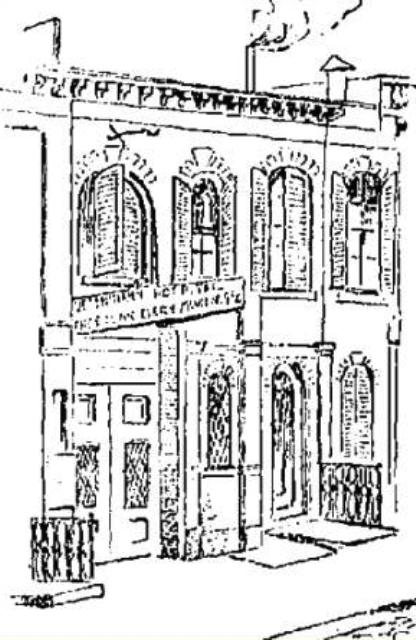
In
the late 1800s, the builder Mr. P.H. McManus erected eight first-class
apartment buildings, with stores, on the east side of 8th Avenue between
135th and 136th Streets. They were named Shenandoah after the river in
Virginia. It was near here that Sarah was caught in the act and arrested
for killing cats.
Sarah
Edward’s idea for establishing a public pound apparently found favor
with the SPCA, which gave the women a stable next to its own stable on
West 22nd Street soon after her court hearing.
In December 1893, Nellie Bly caught up with Grace Devide in a dark tenement after spending several days searching for the transient woman at various apartments. Bly asked Grace to tell her all about the Midnight Band of Mercy.
Grace, who was “living like a pauper and dressed like a beggar,” explained that the women would dress in old clothes and carry airtight baskets lined with oilcloth and sponges saturated in chloroform. They’d go to the slums and pour catnip on the ground to attract the cats, and then put the cats in the baskets and shut the lids. In this manner, the women would kill up to 50 cats a night. Sometimes, she said, they even killed the pet cats of their very own friends.
“The basket would shake, Kitty trying to escape, and then it would go ‘Meow!,’ she explained. ‘Hush Kitty,’ one of our members would say. ‘You are going to Jesus, Kitty! Hush, Kitty, your soul is going to the Lord. Kitty has gone to God, Amen.’
Grace also told Nellie that the women got their first bottle of chloroform from her good friend, Henry Bergh, founder the SPCA. After that, they bought their chloroform for $2.20 a bottle (one bottle could kill 60 cats) from a druggist in the Lower East Side. “One day the druggist said, ‘You buy so much chloroform, you must have a dyeing establishment.’” The midnight cat killer replied, ‘Yes, a dying establishment.’”
This
1916 photo shows the John Ewen estate, which was located on land
overlooking Kingsbridge in the Bronx. Today the land is the site of Ewen
Park.
Caroline
Ewen, a major benefactor of the Midnight Band of Mercy, attended
evangelical services at the Gospel Tabernacle at the corner of 44th
Street and 8th Avenue. Today the building is home to John’s Pizzeria of Times Square and Angus’ Café Bistro.
Mrs. Van Orden told Nellie that Sarah and the other ladies would often kill the pet cats that were boarding at the home – and then continue collecting the boarding fees from the owners. She said she tried to save these cats by putting ribbons on them and keeping them in a separate room, but her efforts did not deter the cat killers.
The End of the Band of Mercy
I don’t know whatever became of Sarah Edwards, but I do know that in 1896 Grace Devide was a member of Mrs. Charlotte Smith’s Woman’s Rescue League at 24 Union Square. She had reportedly showed up at Mrs. Smith’s home for wayward women looking for shelter because “she was without means and didn’t know what to do.” Charlotte said she could stay in one of the rooms rent-free and do work for the WRL until she could get her life together. Hopefully that work did not involve any midnight raids of mercy.
In 1921, 162 lots in the Kingsbridge and Riverdale neighborhoods of the Bronx were sold at auction for the heirs of Caroline Ewen and her sister Louise. The land, which had been in the Ewen family for 78 years, adjoined a park (Ewen Park), which had been given to the city in 1916 by their other sister, Eliza M. Ewen. The proceeds of the sale were to go to all the homeless and suffering dogs, cats, and other animals of New York, Boston, Philadelphia, London, Rome, Naples, and Madeira.
Today,
the former site of the Midnight Band of Mercy’s home for friendless
cats in Washington Heights is occupied by the Wilf Campus of Yeshiva University, which opened in 1928 with an enrollment of 31 students.
